A while back a couple came to me wanting a website. They had a real business and a real plan, and they told me up front that most of what they had saved was already spent on starting the business and there wasn't much left for a build. I worked out a deferred-payment arrangement with them, a small amount up front and the balance over time as the business started generating revenue. The site went live and the business is growing.
That conversation isn't unusual for me. Most of my clients aren't venture-backed startups or enterprise teams with locked-down annual budgets. They're small businesses, sole proprietors, and people with great ideas who often can't write a $50,000 check before seeing whether the work pays off. Over the past few years I've worked out a pricing approach that explicitly makes room for that, and I've started using it consistently enough that I want to name it: Stepped Investment.
What it is
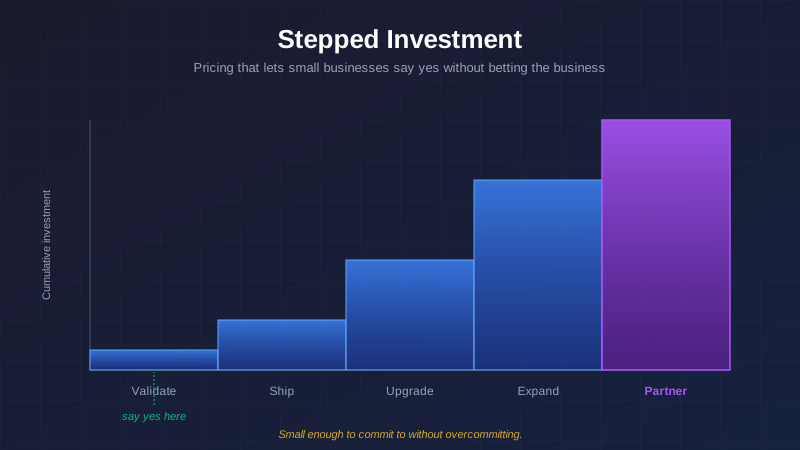
Stepped Investment is a way of structuring engagement pricing so the early stages are deliberately small, small enough that a small-business client can say yes without betting the business. Each subsequent stage gets bigger as the engineering complexity grows and the customer's business proves traction. Each stage is a discrete deliverable that stands on its own as something useful, and between stages the client makes a separate decision: keep going, or stop here.
The shape is a staircase rather than a flat fee or a uniform hourly rate.
- Stage 0, Validation. Usually a few thousand dollars. Confirms there's a real market and a real path. Sometimes the right answer here is "don't build this."
- Stage 0.5 / Stage 1, the original-vision ship. A working version of what the client originally described, scoped honestly and priced small. They get a product they can put in front of real customers.
- Stage 2 and beyond, the upgrades. Bigger investments that build on the foundation and reflect their real engineering cost. The client funds these as the business proves the demand.
- Final stages, partnership and integration work. Often the most substantial legwork involved (legal review, agency negotiations, security review cycles), priced honestly at or above market.
The total cost of the full build often ends up at fair market. But the path to get there is structured so the customer is never one big commitment away from finding out their idea doesn't work.
Why I work this way
I'm a one-person shop. I could in theory charge fixed-bid prices that maximize my revenue on every engagement, and some clients would pay it. But over time I've found I'd rather have five clients growing into bigger engagements than one big client who didn't make it. The early-stage discount isn't really a discount, it's an investment in the relationship and in the client's odds.
It also matches how I think about my role. I'm a builder helping a business grow, not a vendor selling a fixed deliverable. If the business doesn't grow, neither does my engagement with them, and that alignment shows up in the pricing curve.
How this has worked in practice
The couple from the opening: their site is up, the business is running, and we settled the balance over time as planned.
I built a complex 10-state application workflow system for a small charity and got paid in massage sessions through a barter arrangement with a mutual friend who runs a practice. Not cash, but a real exchange that worked for both sides.
I built a field-operations platform for a construction services business. It's a full Blazor web app paired with a MAUI Android app: GPS tracking, work-order management, photo pipelines, and dashboards. Roughly 700 hours of focused engineering. The rate I charged is well below what the work would cost at market. I'm proud of it and I'd do it again, and the business is running its production pilot this month.
I'm currently scoping a domain-specific mobile app for a new client. The full build, taken stage by stage, will probably land in the same range bigger clients pay for similar scope. But the first decision they have to make is a small one, and so is the second. They get to see the product in market before committing to the bigger stages. The staircase keeps the early steps accessible.
The trade-off, honestly
This model is less lucrative per project than fixed-bid pricing. I make less up front than I'd make charging market rate from day one. But over a portfolio of clients, the model produces better outcomes for me too: I have more engaged clients, I keep relationships longer, and I'm building real businesses rather than shipping code into the void.
It also means I sometimes do work that wouldn't pencil out as a pure hourly engagement. A small charity might get more hours from me than the dollar figure suggests, because the mission is worth it. A friend's business might get a friend rate. A startup might get a deferred-payment plan because the cash isn't there yet but the work needs to ship. None of those are charity, they're investments that pay back in different ways.
If you're looking at it from the other side
If you're a small business owner or solo founder talking to a builder about a project, here's what I'd suggest looking for:
- Can the engagement start small? You shouldn't have to commit your whole budget before seeing whether the work pays off.
- Is each stage a real deliverable? Not a prototype or a slide deck, but something you can put in front of customers and learn from.
- Is there a clear go/no-go between stages? You should be making fresh decisions with new information, not signing up for the whole thing in advance.
- Does the builder care if your business grows? Pricing structure tells you more than any pitch deck about whether they're aligned with your success or just billing against your budget.
If those things are present, the exact pricing model probably doesn't matter that much, and if they're not, the model is the first thing I'd fix.
The Services page has the short version of this pricing approach if you want to share it with someone. This post is the longer explanation behind it.